
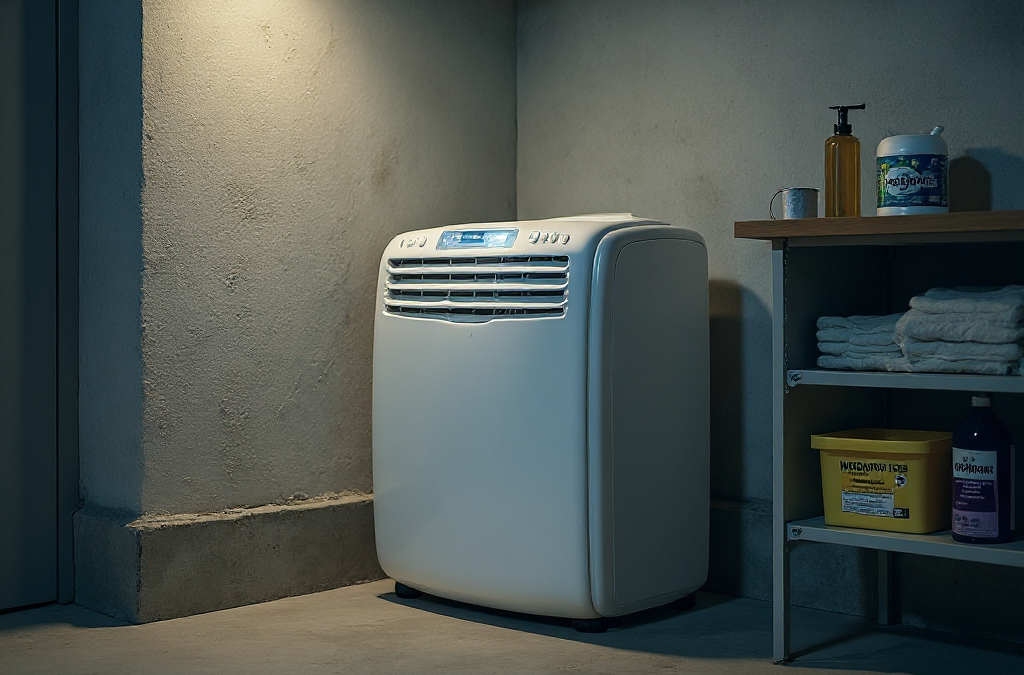
Introduction: The Importance of Managing Humidity in Basements
As the peak humidity season approaches, it’s essential to address one of the most overlooked yet key areas of your house: the basement. Basements and crawl spaces are prone to high humidity levels, which can lead to a plethora of issues, including mold growth, musty odors, and significant damage to your property.
Mold, in particular, thrives in humid environments, feeding on moisture and multiplying rapidly, which can compromise the structural integrity of your home and adversely affect indoor air quality. By managing humidity effectively, you can prevent mold growth, protect your belongings, and ensure a healthier living space.
A key component in this battle against humidity is the use of a basement dehumidifier, a device specifically designed to remove excess moisture from the air, thereby creating an environment that is less conducive to mold spores and other moisture-related problems.
Choosing the Right Dehumidifier for Your Basement
Understanding Capacity and Coverage
When selecting a dehumidifier for your basement, it’s essential to choose a unit that matches the size and humidity conditions of your space. To determine the right size, you need to consider the square footage of your basement and the level of humidity. A simple way to do this is by using a dehumidifier sizing chart or calculator. For example, if your basement is moderately damp with occasional musty odors (indicating 60-70% humidity), you would need a dehumidifier with a capacity of around 35-40 pints for an 800 square foot area. Additionally, the sealing of your building plays a significant role. For larger areas like basements or whole house applications, you should consider whether your building is loosely, moderately, or tightly sealed. A tightly sealed building, for instance, might require a dehumidifier with a capacity of 100-155 pints to cover up to 4,400 square feet.
Considerations for Drainage and Maintenance
Drainage is another critical aspect to consider when choosing a dehumidifier. You have several options to manage the water collected by the unit. A drainage bucket is the most common method, but it requires regular emptying to prevent overflow. For more convenience, you can opt for a dehumidifier with a continuous drain feature, which allows you to connect a hose to the unit and direct the water to a drain or outside, eliminating the need for frequent bucket emptying. Maintenance is also an important factor. Look for dehumidifiers that are easy to clean and have washable filters to ensure optimal performance and air quality. Energy Star certified dehumidifiers are not only more energy-efficient but also easier on the environment, making them a wise choice for long-term use.
Advanced Features for Enhanced Convenience
Modern dehumidifiers often come with advanced features that enhance their functionality and convenience. One such feature is the ability to set a desired humidity level, allowing the dehumidifier to power on and off as needed to maintain the optimal relative humidity. This feature ensures that your basement remains at a comfortable humidity level without constant monitoring. Other features to look for include built-in humidistats, automatic shut-off when the tank is full, and quiet operation. Some dehumidifiers also come with built-in air purifiers or filters that help improve indoor air quality by removing mold spores and dust mites from the air .
Supplementary Techniques to Reduce Humidity and Prevent Mold
Improving Airflow and Ventilation
In addition to using a dehumidifier, improving airflow and ventilation in your basement is crucial for maintaining a dry and healthy environment. Basements, being partially or fully below ground level, often suffer from poor air circulation, which can lead to stagnant, damp air that fosters mold growth. To enhance ventilation, consider installing windows or egress windows, especially in areas protected from extreme weather. Even if you already have windows, propping them open during favorable weather conditions can allow fresh air to enter and circulate within the basement. For basements with limited natural ventilation, mechanical solutions can be highly effective. Installing ceiling fans or using box fans and oscillating fans can help keep the air moving, reducing the likelihood of stagnant air pockets where mold can thrive. However, it’s important to note that while fans improve air circulation, they do not reduce humidity levels; for that, you would still need a dehumidifier or air conditioning system.
Using Moisture Absorbers and Sealants
Besides improving ventilation, using moisture absorbers and sealants can further help in reducing humidity and preventing mold growth. Moisture absorbers, such as silica gel or calcium chloride, can be placed in areas where humidity is particularly high. These products absorb excess moisture from the air, helping to lower the humidity levels and create an environment less conducive to mold growth. Sealants also play a critical role in preventing moisture from entering your basement. Ensure that any cracks or gaps in the walls, floors, and around windows are sealed. This prevents soil moisture and external humidity from seeping into the basement, thereby reducing the overall humidity levels. Additionally, applying a waterproof coating to the walls and floors can help protect against moisture accumulation and subsequent mold growth .
Monitoring and Maintaining an Ideal Humidity Level
Tools for Measuring Humidity
To effectively manage the humidity in your basement, it is essential to use the right tools for measuring humidity levels. There are several types of devices available, each with its own set of features and benefits. Moisture meters are handheld devices that measure the moisture content in various materials such as wood, drywall, and concrete. There are two main types: pin-type and pinless moisture meters. Pin-type meters use metal pins inserted into the material to measure electrical resistance, which is effective for pinpointing specific moisture intrusions but can leave small holes. Pinless meters, on the other hand, use electromagnetic waves to detect moisture without damaging the surface, making them ideal for scanning large areas and testing finished surfaces. For air humidity measurements, digital humidity and temperature monitors are highly effective. These devices, such as those from AcuRite or Ruuvi, provide detailed readings of relative humidity and temperature. They often come with features like LCD screens, Bluetooth connectivity, and mobile app integration, allowing you to monitor conditions remotely and receive alerts when humidity levels exceed set thresholds. Another useful tool is the Humidity Alert Meter, which tracks continuous hours of high relative humidity and alerts you if dangerous conditions persist. This meter provides a continuous readout of current ambient conditions and can be set to sound an alarm when relative humidity limits are exceeded, helping you maintain a healthy and comfortable indoor environment.
Maintaining Optimal Conditions
Maintaining optimal humidity levels in your basement involves more than just monitoring; it requires proactive management. The ideal relative humidity level for a basement is typically between 30% and 50%. This range prevents mold growth while ensuring the space remains comfortable. To maintain these optimal conditions, regularly check the readings from your humidity-measuring devices. If the humidity levels are too high, adjust your dehumidifier settings accordingly. Ensure that your dehumidifier is properly sized for your basement and that it is functioning correctly. Regular maintenance, such as cleaning the filters and checking the drainage system, is also crucial to the dehumidifier’s efficiency. Additionally, consider the overall ventilation and drainage of your basement. Ensure that any water accumulation is promptly addressed, and improve drainage if necessary. This might involve installing a better drainage system or ensuring that the ground around your home slopes away to prevent water from seeping into the basement. By combining the use of advanced monitoring tools with regular maintenance and proactive management, you can maintain an ideal humidity level in your basement, preventing mold growth and ensuring a healthier, more comfortable living space.
Conclusion: Preparing Your Basement for Humidity Challenges
Protecting your home from the challenges of high humidity is a crucial step in maintaining its value, comfort, and safety. By investing in reliable basement waterproofing and dehumidification solutions, you can prevent mold growth, reduce flood risks, and enhance your home’s energy efficiency. Don’t let moisture issues undermine your home’s integrity. Ensure your basement remains dry and healthy by choosing the right dehumidifier, improving airflow and ventilation, and using supplementary techniques like moisture absorbers and sealants. Regular monitoring and maintenance of humidity levels are also essential. For comprehensive protection, consider professional basement waterproofing services that include advanced drainage systems, energy-efficient dehumidifiers, and expert sump pump installations. These solutions are tailored to address unique home needs and local climate challenges. Schedule your free inspection today and take the first step towards a dry, healthy, and worry-free basement. By acting now, you can safeguard your home, your health, and your future, ensuring your basement remains a comfortable and secure space for years to come.
FAQ
How do dehumidifiers work to remove moisture from the air in a basement?
Dehumidifiers work by drawing in moist air through vents, passing it over refrigerated coils, which causes the moisture to condense into liquid water. The water collects in a bucket or drain pipe, and the dehumidified air is warmed and recirculated back into the basement.
What are the ideal indoor humidity levels to prevent mold and other humidity-related issues in a basement?
The ideal indoor humidity levels to prevent mold and other humidity-related issues in a basement are between 30% and 50%, with a preferred range of 40% to 50% during summer and 30% to 55% in winter.
How do I determine the right size and capacity of a dehumidifier for my basement?
To determine the right size and capacity of a dehumidifier for your basement, calculate the square footage by multiplying the length and width of the space. Use a sizing chart to match this area with the appropriate pint capacity, considering the relative humidity level and how tightly the space is sealed .
What are the different drainage options available for basement dehumidifiers, and how do I choose the best one for my needs?
Basement dehumidifiers offer several drainage options:
- Manual Tank Emptying : Standard units collect water in a tank that must be manually emptied.
- Gravity Drainage : Water drains through a hose using gravity, ideal if the dehumidifier is above a drain or sink.
- Hose Hookup : Continuous drainage into a nearby utility sink, floor sump drain, or out a basement window.
- Condensate Pump : Allows for upward, downward, horizontal, or vertical drainage, useful if no convenient drain is nearby. Choose based on your basement’s layout and the convenience you need.
